


Three wise men dig up ancient mysteries

On the last evening of April, Arts Scholars and their guests gathered at Pewterers’ Hall for an evening of talks organised by Renter Warden Mary Foster. All three speakers were eminent archaeologists and members of our Company. The subjects ranged from a site over 7,000 years old to the comparatively recent late 11th century.
First to speak was Michael Lewis, curator of the British Museum’s Bayeux Tapestry exhibition and former head of the Portable Antiquities Scheme. His talk – The Chew Valley Hoard: Discoveries that Changed History – was a fitting combination of both roles. He described how a group of metal detectorists unearthed a remarkable hoard of around 2,500 coins from the late 11th century.
Roughly half bear the profile of Harold II, the remainder William I. One theory suggests the Harold coins were commissioned by Gytha, Harold’s mother, to support her grandsons’ bid to reclaim power from the Normans. Valued at £4.3 million, some coins are now on display at the Museum of Somerset while others are touring. The long-term plan is for the collection to be reunited on permanent display in Somerset.
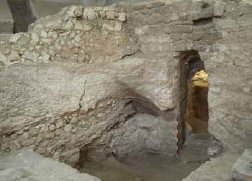
Ken Dark, Professor at the University of Cambridge, then presented Finding Jesus’s House in Nazareth. He explained how he and his team found a house in Nazareth which, he is quite convinced, was known by Jesus. Nazareth has a population of about 65,000, of whom about 30% are Christian. Working backwards through the site’s history, he explained how successive buildings had been constructed there.
In the 1850s, the Sisters of Nazareth built a convent near the Church of the Annunciation. Over time, they carried outextensive excavations, uncovering so many artefacts that many were simply given away. Beneath the convent lay earlier ecclesiastical buildings, including a 5th century Byzantine cave cathedral. Deeper still were the remains of a 1st century dwelling, also described by a 4th century pilgrim, along with two tombs. Was this a house known to Jesus? We can never know for certain, but Ken presented a compelling case that it is possible.
The final speaker, Simon Underdown, Professor of Biological Anthropology at Oxford Brookes University, spoke about excavations in southern Jordan, an area offering early evidence of the shift from nomadic foraging to settled farming some 7,000 years ago. A 2018 discovery revealed a limestone structure. Further excavations in 2023 and 2025 uncovered more, arranged in a channel stretching about one kilometre.
Initially thought to resemble a Neolithic shrine in the Negev Desert, the site has since raised more questions than answers. Tiny tiles dating from the 7th to 5th centuries BCE were found, and ground penetrating radar used with Jordanian colleagues identified additional structures. The purpose of these remains is still unknown, hence the apt title of Simon’s talk, Riddles of the Sands.
No stone tools were found, the channel cannot hold water, it is too small to function as a game fence, and the shaped limestone blocks had been transported from some distance away. With this archaeological mystery left unresolved, Mary gave the vote of thanks and we adjourned to enjoy one of humanity’s most welcome advances: a glass of wine and nibbles.
Miriam Kramer